
Tolland County Estimated Release Date
The Connecticut Department of Correction uses “Estimated Release Date” as the public field closest to a projected or tentative date. The record may also include Minimum Release Date, Maximum Release Date, Special Parole End Date, and Detainer. These labels are not interchangeable. The estimated date reflects the department’s current computation. A maximum date concerns the outside end of the term as calculated. A special parole end date marks the end of post-prison supervision, not the day prison custody ended.
An actual release date records what occurred after all custody steps were resolved. It may differ from the estimate because credits changed, a court corrected the sentence, the parole board acted, a detainer took effect, or a weekend rule moved the practical discharge day. A person can also leave one prison through transfer and remain confined elsewhere. That movement is not a community release.
Pretrial status works differently. Connecticut’s unified correctional system can hold an accused person before conviction, and CT DOC warns that incarceration does not itself prove conviction. Bond, a court order, dismissal, sentence, or transfer may set the next event. There may be no valid projected release date to calculate while the case remains pending.
Find Tolland County Projected Release
The first source depends on where the person is held. Osborn Correctional Institution and Cybulski Community Reintegration Center are CT DOC facilities in Somers, so their dates come from statewide correction records. Northern Correctional Institution closed in 2021; an older Northern association requires current status or movement history. A brief Tolland-area arrest that ended before DOC intake belongs with the court and arresting agency instead.
- Open the CT DOC Inmate Information Search for a state prisoner.
- Use the CT DOC inmate number when known. Otherwise search by last name, first name, and date of birth.
- Confirm identity, status, and current location before relying on any date field.
- Read Estimated Release Date separately from Maximum Release Date and Special Parole End Date.
- Check the Judicial Branch record for the sentence, disposition, jail credit, or later sentence correction.
- When the date remains unclear, ask CT DOC FOI for the official computation, custody dates, and release or transfer history.
CT DOC says its public information is updated daily but may not reflect current status. Same-day timing needs a second source. VINE can send a custody-change alert, while DOC Public Information or the relevant facility can clarify an event that has not reached the public display. The Tolland County release record path covers that broader confirmation process.
Note: “Estimated Release Date: Not Applicable” does not prove release; confirm status, supervision, and current facility before drawing a conclusion.
Tolland County Release Credit Rules
Connecticut General Statutes Section 18-98e creates earned risk reduction credit, often shortened to RREC. Eligible people committed to CT DOC for qualifying crimes may earn up to five days per month at the Commissioner’s discretion. The credit can rest on the offender accountability plan, participation in eligible programs, conduct, and compliance with rules. Good conduct alone does not create a right to credit.
The statute excludes listed offenses and specified persistent dangerous felony or sexual offender categories. RREC cannot cut a mandatory minimum term. CT DOC may withhold or remove credit for misconduct, refusal to take part in recommended activities, or other good cause. Before a release based on such credit, DOC must review and verify the credit. Those limits are why an outside estimate based only on sentence length is unsafe.
The official earned-credit statute capture displays the governing chapter used for Tolland County state-prison release calculations.
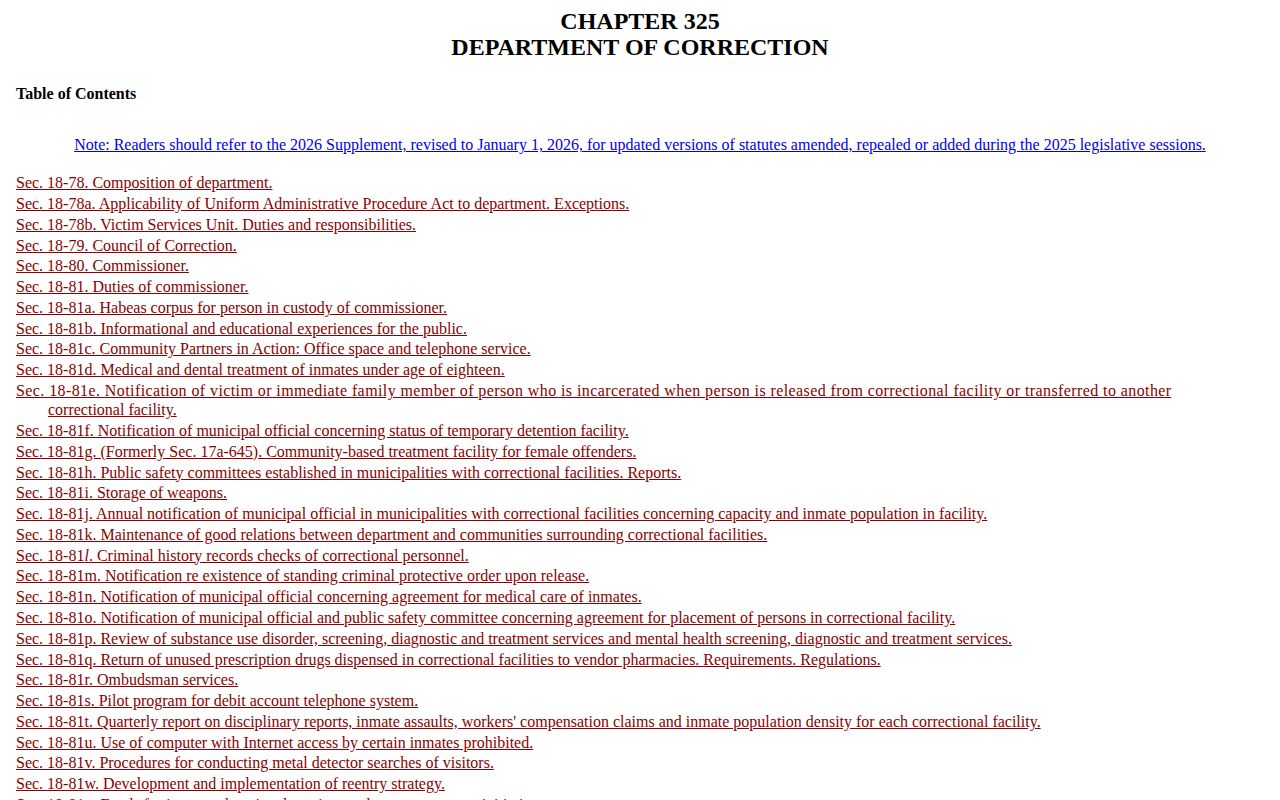
The statute supplies rules, while CT DOC maintains the individual calculation and verifies credits before a qualifying discharge.
Tolland County Parole Release Eligibility
Parole eligibility is not the same as a projected release. Under Connecticut General Statutes Section 54-125a, the baseline for many people serving more than two years begins after one-half of the total effective sentence, less applicable risk reduction credit. Offense type, offense date, statutory exclusions, and board discretion change that result.
BOPP explains that a person in an 85-percent category must serve at least 85 percent of the total effective sentence, less jail credit, before the board may grant parole. For qualifying offenses committed on or after July 1, 2013, BOPP states that RREC does not reduce that parole eligibility date. Some offenses are parole-ineligible. It is therefore wrong to assume every Tolland County prisoner serves either one-half or 85 percent. The controlling offense and dates must be checked.
A board vote is another step, not an exact exit date. BOPP describes voted-to-parole dates as “on or after” dates. Conditions, a release plan, custody processing, or a detainer may still delay or redirect the person. The BOPP parole eligibility page shows the official warning used to interpret these dates.
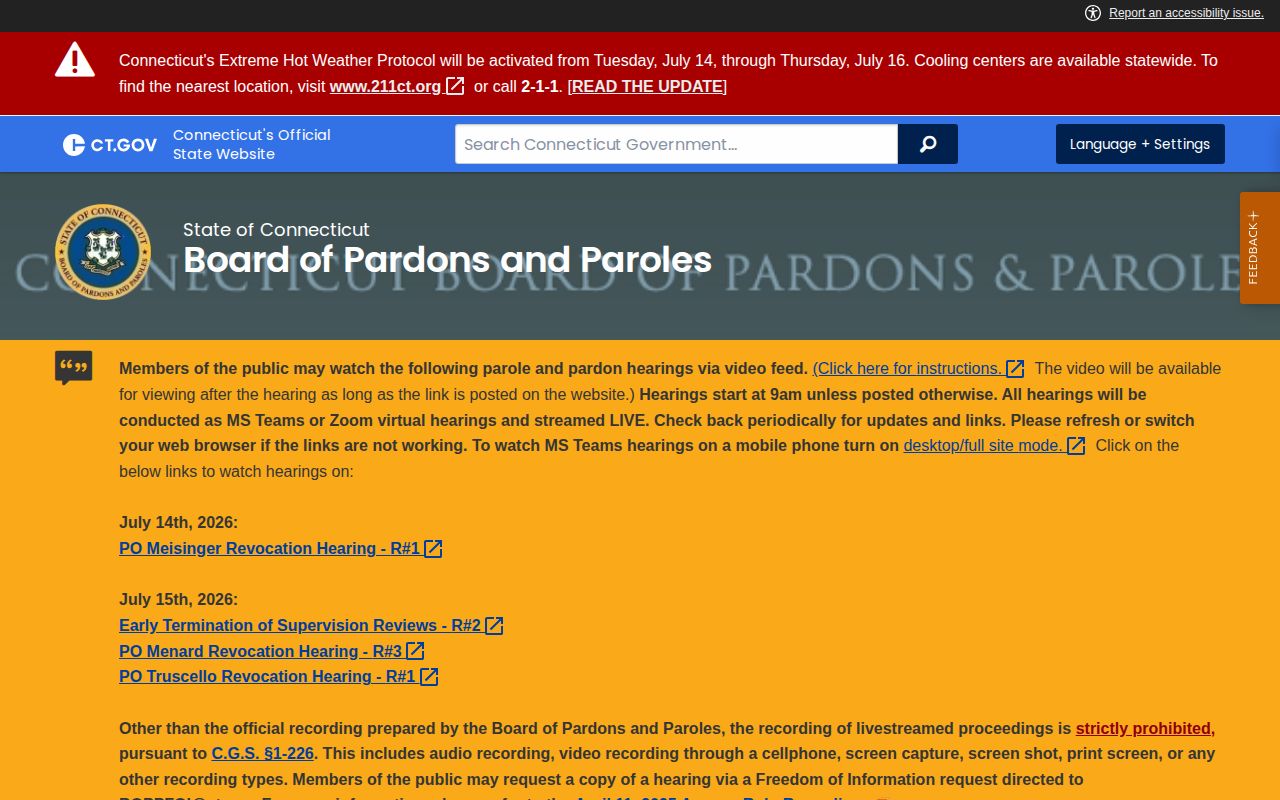
The parole source helps explain the earliest board eligibility point; it does not replace CT DOC’s current custody and estimated-release fields.
Tolland County Release Date Changes
A date can move for reasons found in correction, court, parole, or other-agency records. Some factors affect the mathematical sentence calculation. Others affect only whether the person can enter the community on that date. The distinction matters when a state term ends but another lawful hold begins.
| Factor | Possible effect | Best confirmation |
|---|---|---|
| RREC earned or removed | Changes an eligible CT DOC computation | CT DOC record or computation request |
| Mandatory minimum | Sets time that RREC cannot reduce | Judgment and governing statute |
| Parole action | Grant, denial, continuation, or rescission changes the release path | BOPP record and CT DOC status |
| Detainer | May transfer custody to another authority | CT DOC detainer field and receiving agency |
| Sentence correction | Can alter term, credit, or controlling dates | Judicial Branch case record |
| Weekend or holiday | Can move a term-expiration discharge earlier | Section 18-92 and CT DOC |
A detainer is a notice that another authority may want custody. It can be tied to another state, a federal matter, immigration custody, or another case. A state release to that authority is a transfer, not proof that the person entered the community.
Note: Court sentence data and CT DOC custody data answer different parts of the release-date question and should be read together.
Tolland County Friday Release Rule
Connecticut has a specific answer to the question, “Why did the release happen Friday?” Section 18-92 says that when a DOC inmate’s term expires on a Saturday, Sunday, or legal holiday, discharge takes place on the last business day before it. The rule applies to a term-expiration discharge from CT DOC. It does not mean every parole, court release, transfer, or bond-out scheduled near a weekend must occur on Friday.
This can create a sound difference between a date first noticed in a sentence record and the practical discharge day. For an Osborn or Cybulski release at sentence expiration, check the calendar and then seek CT DOC confirmation. If a person left on Friday but the listed term ended on the weekend, the statute may explain the timing. If parole or a detainer controlled the event, a different record will govern.
Tolland County Community Release Dates
Connecticut General Statutes Section 18-100c provides another route for certain definite sentences of two years or less. Subject to its terms and DOC rules, a person may be released to an approved halfway house, group home, mental health facility, or other community correction program after serving the statutory threshold, less applicable credits. This remains a CT DOC community-program release. It is not a Tolland County sheriff release list entry.
A program placement may look like freedom from a prison building while correctional control continues. Confirm the status label, supervising authority, and address type before calling it a full discharge. Cybulski’s reintegration role makes this distinction especially relevant in Somers, but the legal and record systems remain statewide.
Tolland County Court Release Dates
A pending criminal case can produce a release without a CT DOC estimated date. Bond may be posted, the court may change release conditions, a charge may be dismissed, or the accused person may receive time served. For these events, the Connecticut Judicial Branch criminal and motor vehicle lookup is more useful than trying to calculate a prison term. Its pending-case, daily-docket, conviction, warrant, and sentence-review paths help establish what the court ordered.
Use Tolland Judicial District or Rockville Geographical Area 19 in the court-location field when those locations match the case. The conviction search supports last name, first initial, birth-year range, court location, and criminal or motor vehicle category. Court data can change after corrections, pardons, erasures, or sentence modifications. It also has online display limits. A missing older result does not create a release date and does not prove no case existed.
After finding the docket, separate three dates: the date of the court order, the date the custody agency processed it, and the date the person actually left or transferred. Those dates can differ. A local police agency may be the correct records source when a person bonded out before DOC intake. CT DOC remains the source when the person entered the unified correctional system. If the court changed the mittimus, which is the commitment order sent to correction officials, obtain the updated order and DOC computation rather than relying on the old sentence entry.
Note: Bond eligibility or a favorable court ruling is not the same as a recorded departure from the holding agency.
Confirm Tolland County Actual Release
Use VINE for notice, not for a full sentence computation. Connecticut VINELink can track a specific person and send a custody-change alert. After an alert, recheck CT DOC and the court record. The Tolland County VINELink inmate search explains the state notification steps and limits.
When public fields conflict, request records from CT DOC External Affairs Freedom of Information. Ask for records sufficient to show incarceration dates, sentence computation, movement history, estimated and actual release or discharge dates, release type if public, and any public detainer or transfer notation. Provide the full name, date of birth, inmate number, facility, and date range. The official computation is stronger than a hand calculation based on sentence length.
CT DOC External Affairs Freedom of Information24 Wolcott Hill Road
Wethersfield, CT 06109
Phone: (860) 692-6290
Fax: (860) 692-7873
Online request portal: docct.govqa.us
For parole-decision records, use the BOPP FOI Unit instead. For a short arrest that never became DOC custody, use the arresting police agency and the Tolland Judicial District or Rockville GA 19 court record.