
Tolland County Parole or Probation
A Tolland County release can lead to parole, special parole, probation, or no supervision at all. Parole is release from a Connecticut Department of Correction sentence under terms set through the Connecticut Board of Pardons and Paroles. CT DOC Parole and Community Services administers that supervision. Probation is imposed by a court and supervised through the Connecticut Judicial Branch Court Support Services Division. A person may receive probation after a short custody stay, after time served, or as part of a sentence that does not require prison.
The source must match the status. Osborn Correctional Institution and Cybulski Community Reintegration Center are CT DOC facilities in Somers, so a person leaving either site may move to parole, special parole, transitional supervision, another program, or full discharge. By contrast, someone arrested in a Tolland County town and released on bond may have a pending court case but no parole status. The table keeps those paths separate.
| Point | Parole or special parole | Probation |
|---|---|---|
| Source | State prison sentence and BOPP process | Criminal court order |
| Primary record | CT DOC status, BOPP hearing or decision record | Judicial Branch case disposition |
| Supervisor | CT DOC Parole and Community Services | Judicial Branch Court Support Services Division |
| End point | Parole discharge or special parole end | Completion or court termination of probation |
A CT DOC field labeled “Special Parole End Date” is the end of supervision, not the date the person left prison. That distinction prevents a common error in Tolland County release research.
Verify Tolland County Release Supervision
Begin with the person, case, and custody type. The CT DOC Inmate Information Search can show status, location, release-date fields, a special parole end date, and a detainer when those fields apply. It is a statewide tool, which matters because a Tolland Judicial District case may lead to a prison outside the county. A person housed in Somers may also have been sentenced elsewhere.
- Search CT DOC by inmate number. If it is unknown, use last name, first name, and date of birth.
- Read status and location before reading dates. No active facility may support a release, but it does not by itself identify parole or probation.
- For parole or special parole, check the Connecticut Board of Pardons and Paroles hearing links, calendar, and public process information.
- For probation, search the Judicial Branch criminal case record for the sentence and disposition under Tolland Judicial District or Rockville Geographical Area 19.
- If the online sources are incomplete, request public BOPP or CT DOC records and give the full name, date of birth, inmate number, and useful date range.
The broader Tolland County released inmate search explains how to pair correction, court, VINE, and records-request channels when custody itself is unclear.
Note: CT DOC states that its public inmate information is updated daily and may not reflect a person’s current status.
Tolland County Parole Hearing Records
The Connecticut Board of Pardons and Paroles uses a statewide hearing process. Its homepage posts current livestream links, while future events appear through the Connecticut State Agency Public Meeting Calendar. BOPP says hearings may be held Monday through Friday and generally begin at 9 a.m. unless another time is posted. A Tolland County connection may come from the sentencing court, the person’s home, or a Somers prison. It does not create a separate county hearing calendar.
Hearings use a video link between the board’s main office and the correctional institution. A three-member panel and parole officer take part. The Office of Victim Services and victims or family may also participate when appropriate. After questions, the panel deliberates in open session and gives a decision. Supported outcomes include granted, denied, continued, waived, rescinded, or a new hearing date. Parole remains discretionary, which means eligibility does not promise release.
The official sources do not provide a broad public parole-decision search by a person’s name. When the livestream, calendar, and public pages do not answer the question, request the hearing docket, public decision, or hearing recording through BOPP FOI. The BOPP FOI Unit identifies BOPPFOI@ct.gov as its request channel.
The successful state meeting calendar capture shows where Connecticut parole events are scheduled.
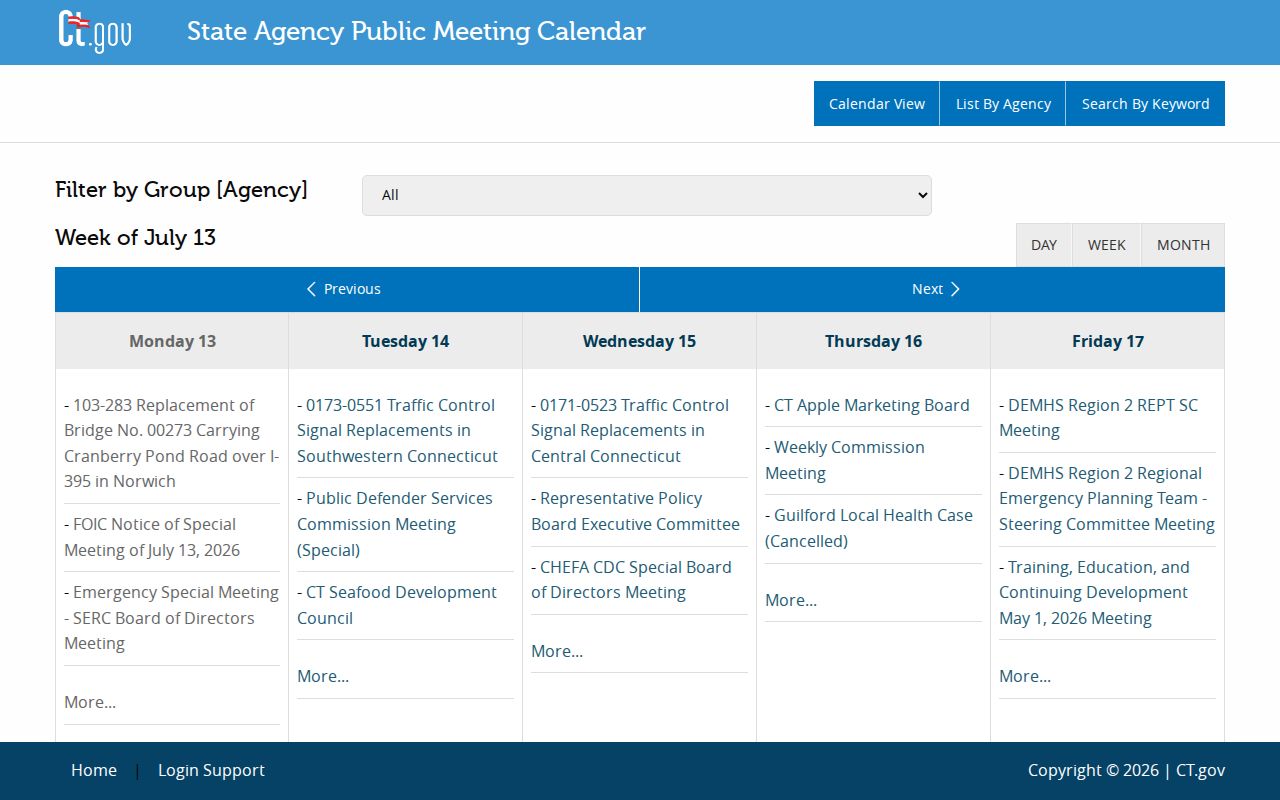
Use the listed event details with BOPP’s daily homepage links, since a calendar entry is a hearing notice rather than proof of release.
Tolland County Parole Date Timing
A favorable vote does not fix the exact day someone walks out of Osborn, Cybulski, or another Connecticut prison. BOPP says a voted-to-parole date is an “on or after” date. Conditions must be set, a plan may need approval, and CT DOC must complete the custody process. A detainer can also redirect the person to another authority instead of the community.
This Tolland County release timing rule explains why BOPP, CT DOC, and VINE may change at different moments. The board record answers what the panel decided. CT DOC answers whether prison custody changed. VINE supplies a custody-change notice for a registered person. When the exact day matters, compare all three rather than treating the board’s date as a guaranteed exit appointment.
Note: A transfer to another authority ends one custody placement but is not the same as release to the community.
Tolland County Supervision Status Changes
Supervision conditions are the rules a person must follow after release. The precise terms belong to the order and case record. At a high level, conditions may govern reporting, approved residence, treatment, travel, contact, and compliance with the law. A violation can produce a warning, added response, warrant, arrest, revocation process, or return to custody, depending on the authority and facts.
An absconder is a supervised person whose whereabouts are unknown after the person stops required contact. It is not a synonym for every missed appointment. A warrant is a court or agency command authorizing arrest. For probation, check the Judicial Branch pending case, conviction record, daily docket, and warrant paths. For parole, the CT DOC and BOPP records are the better starting point. VINELink may report a later custody change but is not a full supervision case file.
- Parole
- Conditional release from prison before the sentence fully expires.
- Special parole
- A court-imposed supervised term that follows incarceration.
- Probation
- Court-ordered community supervision, sometimes imposed without a prison term.
- Absconder
- A supervised person reported out of contact with the supervising authority.
- Discharge
- The formal end of custody or supervision under the controlling record.
Tolland County Release Planning
CT DOC’s reentry structure is a useful local record trail because Osborn and Cybulski are state facilities in Somers. The Offender Reentry Services Unit says each correctional facility has a full-time Reentry Counselor. Intensive work begins during the period before release, and CT DOC’s Transitional Services material says discharge planning begins at least 45 days before release. That work can address documents, benefits, treatment, a residence plan, and the shift to community supervision.
A reentry plan does not prove that Tolland County parole was granted. It can, however, explain why a person nearing release meets with staff or moves through a lower-security setting such as Cybulski. The plan also helps distinguish preparation from the actual legal event. BOPP decides parole suitability where parole applies, CT DOC carries out custody and supervision functions, and the court record controls probation terms.
Connecticut Board of Pardons and Paroles55 West Main Street, Suite 520
Waterbury, CT 06702
Phone: 203-805-6605
Public-record requests: BOPPFOI@ct.gov
The Waterbury office is the statewide board contact. The research did not identify a separate Tolland County parole headquarters or a public probationer locator, so the court case and statewide agency records remain the sound paths.
Tolland County Supervision Discharge
Supervision ends through the authority that imposed or administered it. A special parole end date in a CT DOC record can identify the planned endpoint of that court-imposed term. Ordinary parole ends through the correction and parole process. Probation completion belongs to the Judicial Branch record and any later court order. None of these endpoints should be inferred just because a person no longer appears at a prison.
To confirm a Tolland County supervision discharge, save the relevant CT DOC result, obtain the BOPP public decision or supervision record when parole applies, and check the court disposition when probation applies. If the record is old or no longer visible, use the agency’s FOI channel. Ask for the public dates and status, not a broad personal file. Full discharge means the controlling custody or supervision term ended. It does not erase the court case or correction record by itself.
Tolland County Release ID Retrieval
Identification may remain at the discharging prison if it was not claimed. CT DOC gives a specific process. Offender Reentry Services says identification documents are kept apart from other property and remain at the facility until discharge. Unclaimed documents stay at the discharging facility for 30 days, then move to Central Office for up to two years.
For someone released from Osborn or Cybulski, contact the facility first during that initial period. Afterward, CT DOC directs identification questions to Offender Reentry Services at 860-692-6836, 860-692-7869, or DOC.ORSU@ct.gov. This is a post-release service path, not proof of parole or probation status. Use the supervision records for verification and the ID channel only to locate documents.
Note: Property, identification, supervision, and release-date questions can involve separate CT DOC units even when they concern the same person.